A hot Baltimore afternoon can turn a small AC problem into an urgent decision fast. If you are asking whether to repair or replace air conditioner equipment, the right answer depends on more than whether the system still turns on. Its age, repair history, efficiency, refrigerant, and ability to keep every room comfortable all matter.
A clear diagnosis should come first. A worn capacitor or clogged drain line may be a straightforward repair. A failing compressor in an aging unit may point toward replacement instead. The goal is not to push a new system when a dependable repair makes sense. It is to help you avoid putting good money into an air conditioner that is nearing the end of its useful life.
When Air Conditioner Repair Is Usually the Smart Choice
Repair is often the practical option when the unit is relatively new, has been maintained, and has not needed frequent service. Many AC problems come from individual components that can be repaired or replaced without changing the entire system.
For example, a technician may find a failed capacitor, contactor, fan motor, thermostat, condensate pump, or electrical connection. These issues can stop your cooling system from working correctly, but they do not automatically mean the air conditioner itself has failed. If the rest of the equipment is in sound condition, a targeted repair can restore reliable comfort at a reasonable cost.
Repair is also worth considering when the system is under 10 years old and has a consistent maintenance record. Central air conditioners commonly last 12 to 15 years, sometimes longer with proper care. Age alone does not decide the issue, but a newer system generally has more useful service life left to protect.
A repair may be the right call if your AC has one isolated problem, your energy bills have stayed fairly stable, and your home cools evenly once the unit is running. In these situations, fixing the problem and scheduling regular maintenance can be the most cost-conscious choice.
Repair or Replace Air Conditioner: The Key Factors
The repair-versus-replacement decision is rarely based on one number. A licensed HVAC technician should inspect the system, explain what has failed, and show you how the repair fits into the larger condition of the equipment.
System age and repair history
An air conditioner that is 12 to 15 years old and has required several service calls recently deserves a closer look. Replacing one part may get it running again, but another aging component could fail during the next heat wave. If repair visits are becoming routine, replacement can provide better long-term value and fewer surprises.
It also matters whether the current problem is minor or central to the system’s operation. A thermostat issue is very different from a compressor failure, a leaking evaporator coil, or a major refrigerant problem. Larger repairs on an older unit can be difficult to justify because the system may still have limited life remaining after the work is completed.
Cost of the repair
Many homeowners have heard a version of the 50 percent rule: if a repair costs roughly half the price of a new system, replace the unit. That rule can be a helpful starting point, but it is not a complete answer.
A costly repair on a six-year-old, high-efficiency system may still make sense. A less expensive repair on a 14-year-old unit that has broken down twice this season may not. Consider the repair cost alongside the unit’s age, its expected remaining life, and the likelihood of additional repairs.
A trustworthy estimate should clearly separate immediate repair costs from replacement options. That gives you room to make a decision based on your property, budget, and comfort needs rather than pressure.
Energy efficiency and rising utility bills
Older air conditioners usually use more electricity than modern systems, particularly when they are struggling with worn parts, airflow restrictions, or refrigerant issues. If your summer utility bills keep rising even though your cooling habits have not changed, your AC may be working harder than it should.
A new, properly sized system can improve efficiency, but savings vary by home. Insulation, duct condition, thermostat settings, window exposure, and household occupancy all affect energy use. Replacement is most compelling when the current unit is both inefficient and unreliable, not simply because it is older.
Refrigerant availability
Some older systems use refrigerants that are no longer manufactured for new equipment. Supplies may still be available for service, but they can be more limited and more expensive. If an older unit has a refrigerant leak, the technician should identify and address the leak rather than simply add refrigerant.
When a system using older refrigerant needs a major repair, replacement may be the more dependable path. A new system uses current refrigerant and is designed to meet modern efficiency standards.
Comfort problems throughout the property
An air conditioner that runs constantly, leaves bedrooms warm, fails to reduce humidity, or cycles on and off quickly may have more than a simple mechanical issue. The unit could be undersized, oversized, improperly installed, or affected by duct leakage and poor airflow.
For landlords and small commercial property operators, inconsistent cooling can quickly become a tenant or customer concern. Before replacing equipment, it is important to identify the cause. Installing a larger unit without evaluating load requirements and ducts can create new comfort problems instead of solving the old ones.
Warning Signs That Replacement May Be Near
No air conditioner lasts forever, and most systems give warning signs before they fail completely. Pay attention if your unit needs refrigerant repeatedly, makes grinding or banging sounds, releases unusual odors, freezes up, or runs for long periods without cooling effectively.
Water around the indoor unit also deserves prompt attention. It may be a simple drain issue, but it can also lead to property damage, mold concerns, or shutdowns if ignored. Electrical problems, repeated breaker trips, and burning smells should be handled promptly by a qualified technician.
Replacement becomes more likely when several warning signs appear together. An older unit with poor airflow, high energy use, recurring repairs, and weak cooling is usually telling you that a larger investment is approaching. Acting before a complete failure gives you more time to compare options and schedule installation on your terms.
Do Not Replace an AC Without a Proper Evaluation
A replacement decision should include more than choosing the same size unit that is already installed. Homes change over time. A finished basement, new windows, added insulation, remodeled rooms, or changes in occupancy can affect cooling needs.
A proper evaluation considers the size and layout of the property, ductwork, insulation, airflow, electrical capacity, and the condition of the indoor and outdoor equipment. In many cases, the outdoor condenser and indoor coil should be matched as a complete system. Mixing incompatible components can reduce performance, shorten equipment life, and affect warranty coverage.
For a heat pump system, the decision may also involve your heating needs. In Maryland’s changing seasons, a properly selected heat pump can provide both cooling and heating. The best recommendation should reflect how you use the building all year, not just how it feels during one hot week.
How to Make the Decision With Confidence
Start by requesting a complete diagnosis and an itemized explanation of the issue. Ask how old the system is, what caused the failure, whether the repair addresses the root problem, and what other components may be nearing the end of their service life.
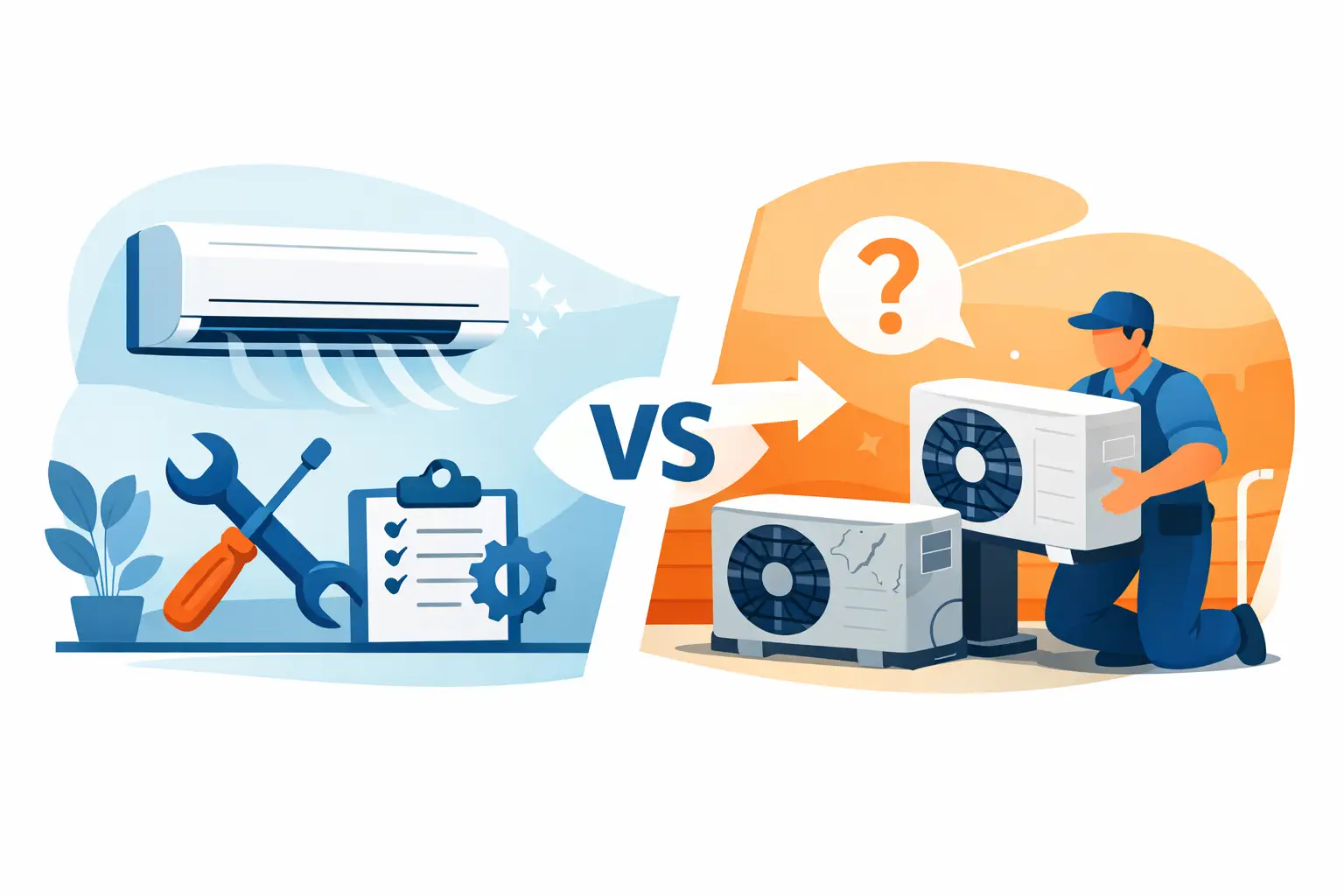
Then compare repair and replacement based on total value. A repair can be the better choice when it restores a newer, well-maintained system. Replacement can be the wiser investment when the unit is old, inefficient, expensive to repair, or no longer delivering dependable comfort.
ABC Cooling & Heating helps homeowners and property managers make this decision with clear recommendations, licensed service, and options tailored to the property. Whether the answer is a quick repair or a carefully planned installation, you should know what you are paying for and why.
The best time to address an AC concern is before a minor issue becomes a no-cooling emergency. If your system is showing its age or struggling to keep up, a professional evaluation can give you a practical path forward and help keep your space comfortable when the heat returns.